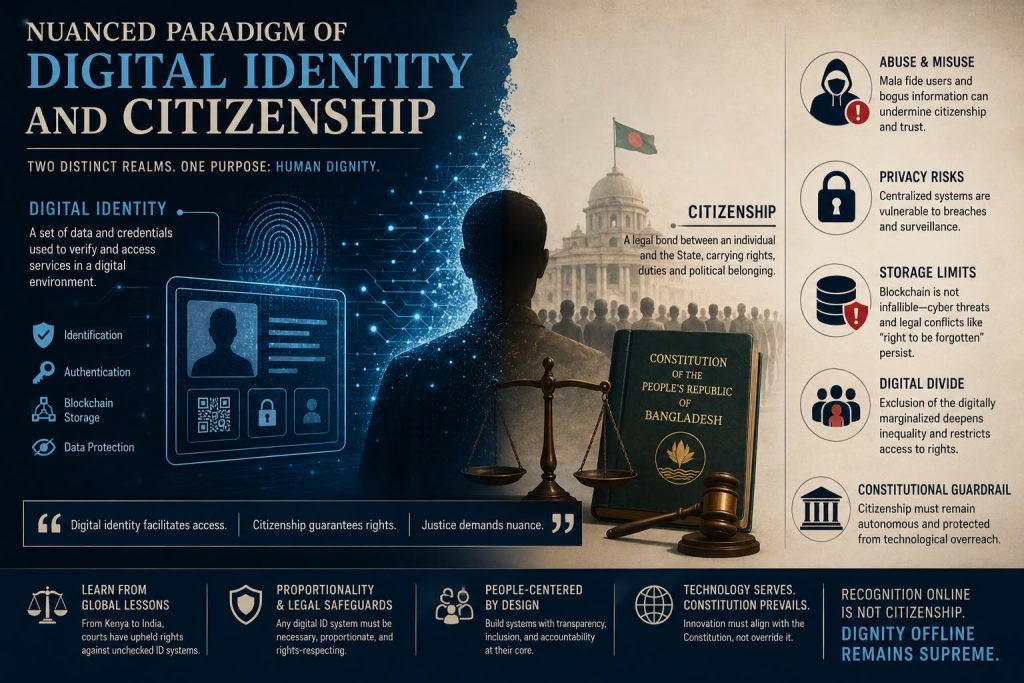
The landscape of digital identity and citizenship: Digital identity describes the set of information required to establish an individual’s identity for official purposes, specifically to access and use public sector services, and is inclusive of legal identity.[1] The information of the identity holder is deemed to be exclusive to the individual. When the transaction identity information on record aligns with the information presented, it opens the door[2] for transactions and requests to be put through.
Citizenship is a legal status and relation between an individual and a state that entails specific legal rights and duties.[3] So, it must be clearly borne in mind that digital identities are a compilation of numbers and figures for the purposes of identification in a digital environment, whereas citizenship is a legal bond between the state and an individual, which consists of legal and political overtones.
It is possible to have a digital identity without possessing valid citizenship, as exemplified by the Estonian “E- Residency” program.[4] Estonia substantially expanded its digital identity program to include persons located outside Estonia who are neither Estonian citizens nor permanent residents. On the other hand, a contrasting approach is in practice in Bangladesh, where digital identities are a medium of exercising citizenship. The NID Card, Smart Card, and Digital Driver’s License that are issued by the Government are only done upon fulfilling the precondition of being a citizen. Thus, it is evident that digital identity and citizenship are not equivalent to each other and should not be attributed equal legal weight. Making the concepts synonymous and interchangeable will only make way for multiple perils.
Abuse of technology: It might consequently lead to abuse of citizenship status. Because on online it is possible to provide correct information to avail services while not being the legitimate user of information, meaning there are “mala fide users” of legitimate information. Also, it is possible to create fake digital information connecting to legitimate users, which can lead to a pool of “Bogus Information” and can hurt the citizenship status of people, if digital identity and citizenship are considered as two sides of the same coin. As a result, the processes of identity accreditation and authentication are more complex, more vulnerable, and less reliable.[5] So citizenship must function as an autonomous spectrum, which is not affected by the operation of digital identities.
Privacy Concerns: When dimensions of citizenship are replicated in an unaltered way on the digital landscape, it becomes more vulnerable to breaches of privacy. Accordingly, domestic laws establishing digital identity programs must determine with enough clarity their scope of application, the safeguards on data storage, duration, usage, destruction, and access of third parties, as well as the guarantees against arbitrariness and abuse.[6] As visible with the Aadhaar information breach in 2018 in India, wherein the private information of over 1 billion individuals had been compromised, the risks of centralized digital identification systems have to be carefully controlled.[7] Most importantly, to incorporate caution that even if digital identities are compromised, the citizenship status must remain in its original form.
Method of Storage: Digital identities are operated by the Blockchain technology. Blockchain technology consists of a distributed database in which transactions are recorded in blocks linked by cryptographic techniques. Specifically, it offers record immutability, decentralized information storage, and end-to-end transaction traceability.[8] Despite its strong technological base, it is still not immune to cyber-attacks and large-scale infiltrations. Blockchain’s inherent immutability can clash with regulations such as the European Union’s “right to be forgotten” under the General Data Protection Regulation.[9]
The Void in Identities: The uniqueness and singularity of identity in the physical world are in clear contrast with the variety of identities commonly used in the virtual world. As an outcome of this situation, there is a weak link or even a real divorce between physical and digital identities.[10] In this scenario, importing the core foundations of citizenship into the digital foray is likely to make the waters even murkier. Furthermore, the digital identity framework has the potential to aggravate marginalization and discrimination. The digital divide and generational gap will inevitably produce a segment of people who will fall behind in the journey and, in the process, will also be deprived of the benefits of a digital identity. It could very well be the case that individuals having citizenship are not able to realize their rights to the fullest extent, only for not being on the digital map.
The Limits of Digital Identity: The boundaries of digital identities should not be interpreted in an overreaching manner. According to the Consultative Committee of the Convention of the Council of Europe, the concept of legal identity has been developed from Article 6 of the Universal Declaration of Human Rights, which states that everyone has the right to recognition everywhere as a person before the law.[11] Legal identity is conceived as a right in the report of the Secretary General of the United Nations,[12] and providing legal identity for all is the 16.9 goal of the UN 2030 Sustainable Development Strategy.[13] But it must be noted that digital identity in itself does represent legal identity in its entirety. Legal identity is said to be attained by the formal recognition of the State, and digital identities are a subtle digital representation through credentials, and legal identities are the source of the said digital representation. Keeping in view the conceptual constructions, digital identities should never be elevated to the level of citizenship, otherwise it would amount to unwarranted interference with the regime of citizenship. In summary, the right to identity is about more than just control of personal information, as it is the recognition that an individual has an inalienable interest in the uniqueness of his being.[14]
A Judicial Outlook on Nuances: In 2019, the government of Kenya sought to create a national ‘digital ID’ to address concerns over existing multiple but disjointed identity systems. The objective was to create and operate a national population register as a single source of information about Kenyan citizens and foreigners resident in the country.[15] The High Court of Kenya[16] cautioned that schemes of national identity should only be in place where there is a pre-existing legal framework to safeguard the rights of citizens, as the prevailing scheme in the country was adjudged intrusive to citizen rights. It was learned that even the data collection mechanism for creating digital identities can infringe variety of civil rights.
Moreover, a 2019 ruling, the Jamaica Supreme Court declared their digital national identity scheme unconstitutional, null, void and of no legal effect.[17] The court provided a comprehensive examination of measures that are both proportionate and necessary in a democratic society to fulfill the state’s legitimate objectives when introducing a national digital ID system. Its breakdown of the proportionality test and the elements required offers substantial direction for stakeholders planning or challenging the rollout of such systems, highlighting how to balance state aims with individual rights. Hence, the ruling highlights the significance of evaluating the impact of digital ID systems on human rights.
In 2009, the Indian Government began to implement the Aadhaar program with the objective of issuing a unique identification number to all residents of India. In 2014, the Department of Telecommunications issued instructions to all Indian mobile operators requiring them to collect and record a customer’s unique Aadhaar number as part of the mandatory SIM registration process.[18] It could be visualized that linking SIM registration and Aadhaar created a surveillance foundation unlawfully infringing on the fundamental right to privacy, deemed to be a constitutional right. In a landmark ruling of the Supreme Court of India in 2017,[19] the court ruled out many procedures of creating the Adhaar Card for being untenable, because the means could not be termed as legally grounded only in view of the legitimate objective to be achieved and expressed concern whether such national-level projects will have a chilling effect on the right of the citizens.
Another relevant anecdote could be where digital identity designs did not suit in aiding non-citizens. In 2018, the UNHCR implemented a program to establish a unified database for the purposes of protection for an estimated 900,000 refugees who have fled from Myanmar to Bangladesh.[20] The Engine Room study shows that the process of identification among Rohingya refugees resulted in multiple fears and concerns about the purpose of the digital ID system, and refugees falsely believed that accepting a digital identity card would lead to their repatriation to Myanmar and to the circumstances that led to their fleeing the country.[21]
Bottom-line: As tempting as the prospects might sound, digital identity should not be an alternative to the physical bases of citizenship. The pragmatic approach of globalizing digital identity must have its breaks on requisite junctures, and the two concepts should prevail in their own domain while having permissible convergences that are suited to the legal, social, and ethical framework of States.
Footnotes:
[1] Clare Sullivan and Scott Tyson, ‘A Global Digital Identity for All: The Next Evolution’ (2023) 6 Policy Design and Practice 433.
[2] ibid.
[3]‘Center for the Study of Citizenship, What Is Citizenship?’ (Wayne State University, undated) <https://csc.wayne.edu/what-is-citizenship> accessed 15 November 2025.
[4] e-Residency of Estonia, e-Residency (Republic of Estonia, undated) <https://www.e-resident.gov.ee/> accessed 15 November 2025.
[5] Irina A Filipova, ‘Creating the Metaverse: Consequences for Economy, Society, and Law’ (2023) 1 Journal of Digital Technologies and Law 7.
[6] Ana Beduschi, ‘Digital Identity: Contemporary Challenges for Data Protection, Privacy and Non-Discrimination Rights’ (2019) Big Data & Society January–June 1 <https://doi.org/10.1177/2053951719855091> accessed 15 November 2025.
[7] Udbhav Kumar Garg, ‘The impact of digital identity systems on citizenship rights’ (2025) 13(4) International Journal of Creative Research Thoughts (IJCRT) 25A4815.
[8] Leonardo Juan Ramírez López, Danniel Alejandro Parra Chavarro and Yeison Andres Hernandez Huertas, ‘Digital Citizenship: Challenges and Uncertainty in Applying Blockchain’ (2025) 8 Frontiers in Blockchain <https://doi.org/10.3389/fbloc.2025.1682474> accessed 15 November 2025.
[9] N Anand and I Brass, ‘Responsible Innovation for Digital Identity Systems’ (2021) 3 Data and Policy e35 <https://doi.org/10.1017/dap.2021.35> accessed 15 November 2025.
[10] Steve Saxby, ‘The 2013 CLSR-LSPI Seminar on Electronic Identity: The Global Challenge’ (2014) 30(2) Computer Law & Security Review 112–125.
[11] Consultative Committee of the Convention for the Protection of Individuals with regard to Automatic Processing of Personal Data of the Council of Europe, Guidelines on National Digital Identity (2023) 6 <https://edoc.coe.int/en/data-protection/11578-guidelines-on-national-digital-identity.html> accessed 15 November 2025.
[12] United Nations, ‘Our Common Agenda’ (UN, 2021) <https://www.un.org/en/un75/common-agenda> accessed 15 November 2025.
[13] United Nations, ‘Transforming our world: the 2030 Agenda for Sustainable Development’ (UN SDGs) <https://sdgs.un.org/2030agenda> accessed 15 November 2025.
[14] J Neethling, J M Potgieter and P J Visser, Neethling’s Law of Personality (2nd ed, LexisNexis Butterworths, Durban 2005) 36.
[15] Open Society Justice Initiative, ‘Kenya’s National Integrated Identity Management Scheme (NIIMS)’ (Briefing Paper, January 2020) <https://www.justiceinitiative.org/publications/kenyas-national-integrated-identity-management-scheme-niims> accessed 15 November 2025.
[16] Nubian Rights Forum & 2 others v Attorney General & 6 others [2020] eKLR.
[17] Julian Robinson v The Attorney General of Jamaica (Claim No 2018HCV01788, Supreme Court of Jamaica, 30 May 2019) [2019] JMCC Full 5.
[18] ‘DoT asks telecom companies to collect Aadhaar number for issuing new SIMs’ (ETTelecom, 2 October 2014) <https://telecom.economictimes.indiatimes.com/news/policy/dot-asks-telecom-companies-to-collect-aadhaar-number-for-issuing-new-sims/45011495> accessed 15 November 2025.
[19] Justice K S Puttaswamy (retd) and anr v Union of India and ors 2017 10 SCR 569.
[20] UNHCR, ‘Joint Bangladesh/UNHCR Verification of Rohingya Refugees Gets Underway’ (UNHCR, 31 July 2018) <https://www.unhcr.org/en-us/news/briefing/2018/7/5b3f2794ae/joint-bangladeshunhcr-verification-rohingya-refugees-gets-underway.html> accessed 15 November 2025.
[21] The Engine Room, Understanding the Lived Effects of Digital ID: A Multi-Country Study (2020) <https://digitalid.theengineroom.org/assets/pdfs/200128_FINAL_TER_Digital_ID_Report+Annexes_English_Interactive_Edit1.pdf> accessed 15 November 2025.

Md. Fiaz Rabbani
Latest posts by Md. Fiaz Rabbani (see all)
- Nuanced Paradigm of Digital Identity and Citizenship - August 6, 2026