1. Introduction: Feminist scholar and author Catherine A. McKinnon characterized the state as being jurisprudentially male, which means it predominantly adopts the male point of view on the relation between law and society.[1] The dominance of male perception in state affairs becomes more obvious when it tries to control women’s reproductive rights, whether during war or in peace.
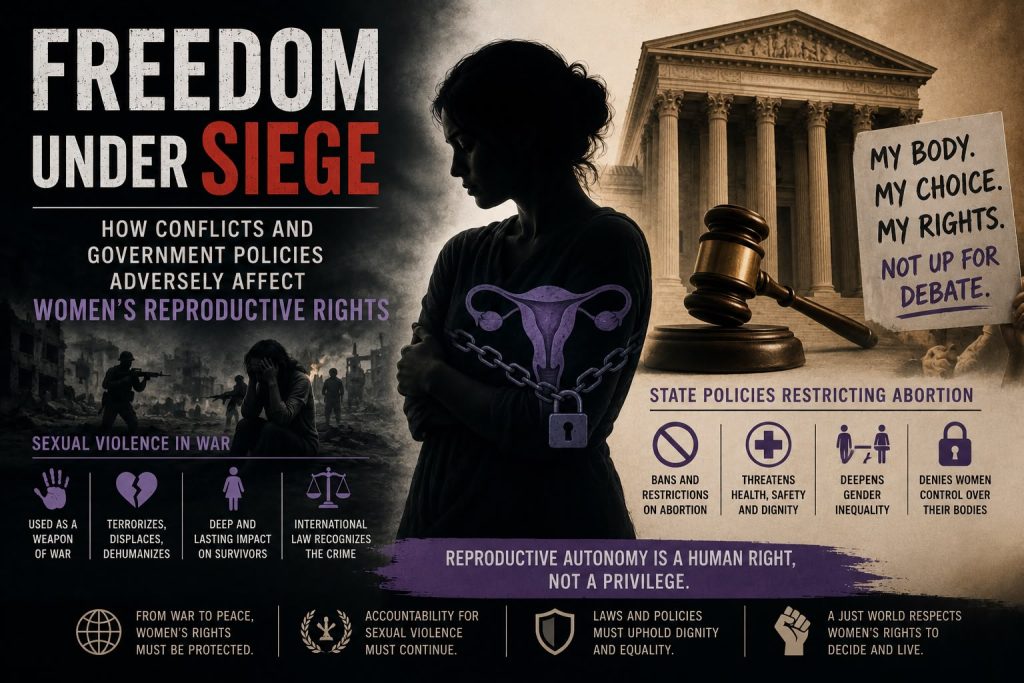
During armed conflicts, rape and other forms of sexual violence are often used as a weapon of war.[2] Along with dehumanizing the victims, rape is used as a means of terrorizing civilian populations and demoralizing enemy troops[3], often to displace the civilians from an area.[4] Rape and other forms of sexual violence can also be inflicted upon men and boys, whether during conflicts or in peacetime.[5]
Apart from violent conflicts, women’s reproductive rights may also be affected in times of peace, primarily by state policies barring or restricting their access to abortion. Though international humanitarian law does not recognize a right to abortion, it falls within many recognized human rights. Depending on the circumstances, restrictions on abortion may be viewed as a violation of the right to life; right to health; right to privacy/autonomy; right to equality/freedom from discrimination; and right against torture or cruel, inhuman, or degrading treatment.[6] Thus, whether through the brutalities of conflicts or coercive state policies, women’s reproductive autonomy remains deeply vulnerable to outside control. This phenomenon underscores a critical evaluation of various real-world instances and legal frameworks to understand how armed conflicts and state practices continue to shape, prevent or restrict women’s reproductive rights.
2. Definition of Reproductive Rights: According to the World Health Organisation (WHO), “Reproductive rights rest on the recognition of the basic right of all couples and individuals to decide freely and responsibly the number, spacing and timing of their children and to have the information and means to do so, and the right to attain the highest standard of sexual and reproductive health.”[7] They also include prenatal services, safe childbirth, and access to contraception, together with access to legal and safe abortion.[8]
Reproductive rights have been recognised as human rights for the first time in the Cairo Programme of Action, 1994. It was recognized that because of biological, social, and cultural reasons, women are far more affected by the absence of reproductive rights than men and such rights are central to women’s ability to realize their human rights.[9] However, while very few countries explicitly enshrine reproductive rights in their constitutions, some of them have highly restrictive state policies towards abortion[10], effectively undermining women’s reproductive freedoms.
3. Sexual Violence in War: Legal Frameworks and Landmark Prosecutions: The term ‘rape’ was defined by three international cases. The first is the Akayesu case,[11] where the International Crimes Tribunal for Rwanda (ICTR) adopted a very broad definition of rape, holding that rape is “a physical invasion of a sexual nature, committed on a person under circumstances which are coercive.” In a later case, the International Crimes Tribunal for the former Yugoslavia (ICTY) conducted a comparative analysis of rape laws from various national jurisdictions to derive the “common denominators” of rape. It concluded that the actus reus of rape comprises:
i) the sexual penetration, however slight: a) of the vagina or anus by the penis of the perpetrator or any other object used by him, or b) of the mouth of the victim by his penis; ii) through coercion or force or threat of force against the victim or third person.[12]
However, in the Kunarac case, the Tribunal considered the Furundžija definition too narrow, holding that an act of sexual penetration constitutes rape not only if accompanied by “coercion or force or threat of force against the victim or a third person”, but also if there are other factors which would render the act “non-consensual or non-voluntary” on the part of the victim. The key criterion is therefore the lack of consent or voluntary participation.[13]
In Akayesu, the ICTR held sexual violence as “any act of a sexual nature which is committed on a person under circumstances which are coercive”.[14] The term “act of a sexual nature” is very broad. It may range from penetration to comments having a sexual indication.[15] “Coercion” can be understood broadly as including not only a show of physical force but also “[t]hreats, intimidation, extortion and other forms of duress which prey on fear or desperation”.[16] The Trial Chamber further held that “sexual violence is not limited to a physical invasion of the human body and may include acts which do not involve penetration or even physical contact”.[17] From this definition, it is clear that sexual violence has a broader threshold than rape.[18]
The term has been liberally defined by the WHO as “any sexual act, attempt to obtain a sexual act, unwanted sexual comments or advances, or acts to traffic, or otherwise directed, against a person’s sexuality using coercion, by any person regardless of their relationship to the victim, in any setting…” [19] It appears that the threshold of gravity is very low under this definition and that the term “violence” encompasses not only physical but also verbal or psychological violence.[20] Rape and other forms of sexual violence were recognized as crimes against humanity[21] and war crimes[22] by the Rome Statute.
The ICTY is the first international court to prosecute offenders on charges of rape and sexual violence. These three landmark cases, e.g. Prosecutor v. Tadić,[23] Prosecutor v. Delalić and Others[24] and Prosecutor v. Furundžija,[25]were the earliest prosecutions of sexual violence by the ICTY. In Tadić, the Tribunal prosecuted the charges against Duško Tadić of rape, torture and mutilations of prisoners in prison camps, though rape charges were ultimately dropped due to the witness’s absence.[26] In Čelebići, the Tribunal tried multiple defendants for brutal crimes committed in a prison camp, including repeated rapes of female prisoners and sexual violence against male detainees, with the conviction based on direct participation and command responsibility.[27] In Furundžija, the Tribunal found a military commander guilty of failing to prevent rape of a female detainee during interrogation.[28] In 2001, in a series of cases, multiple defendants were convicted for systematic sexual enslavement and abuse of Muslim women and girls in the Bosnian town of Foča.[29] This is the only time an international tribunal tried sexual enslavement.[30]
The Rwandan Genocide was characterized by systematic rape and sexual violence including sexual enslavement and forcible pregnancy, targeting the Tutsi womanhood.[31] Prosecutor v. Akayesu was one of the most phenomenal cases tried by the ICTR relating to sexual violence perpetrated during the genocide, where Akayesu, a community leader, was charged with genocide, complicity in genocide, and sexual violence.[32] The defendant was found guilty of ordering, instigating and aiding rape and sexual violence, with the Court recognizing rape and sexual violence as an integral part of the Rwandan Genocide.[33]
Even the heads of state are no longer exempt from prosecution for rape and sexual violence. On 30 May 2016, former Chadian dictator Hisséne Hebré was convicted by a special tribunal for rape, torture and crimes against humanity, making him the first former head of state to be convicted of rape anywhere.[34]
4. Barring Access to Abortion: A War on Women’s Reproductive Rights: Nowhere is the controversy surrounding abortion right is as acute as in the US. Primarily, the US Supreme Court took a liberal stance in relation to access to abortion, affording some measures of protection to the women seeking abortion. For example, in Roe v. Wade,[35] the Court invented a trimester-based approach, directing that the state can only bar or restrict access to abortion after the fetus has reached the stage of ‘viability’. However, this judgement kept the scope of state-imposed restrictions on the abortion right particularly during the second and third trimester periods which enabled the conservative state governments to dismantle the abortion regime brick by brick.
Eventually, in a controversial judgement,[36] the conservative-dominated Supreme Court struck down the Roe decision, thus giving individual states the right to regulate abortion as they like. As of August 2024, 17 states outlawed nearly all abortions, with some having narrow exceptions for rape, incest or the mother’s health.[37] Another 8 states allow some access to the procedure, barring abortion some time between 12 and 23 weeks of pregnancy.[38] It is reported that about 520,000 rapes led to 64,565 pregnancies in the 14 states that enacted abortion bans,[39] causing severe mental, physical or financial pressures on the mother. Globally, 21 countries ban abortion entirely, with 100 countries banning it subject to some restrictions.[40]
Conclusion: From the above observation, it appears that though the international community has gained some leeway in addressing concerns of sexual violence against women, there is an absence of a comprehensive framework respecting their right of access to abortion. An all-encompassing documentary framework is therefore urgently required to be designed to give individual states an outline to design their own abortion laws, protecting both social harmony and reproductive rights.
Footnotes:
[1] Catherine A. McKinnon, Toward a Feminist Theory of the State (1st edn., Harvard University Press, 1989) 163.
[2] Caroline Kapp, ‘The Devastating Use of Sexual Violence as a Weapon of War’ (Think Global Health, 2 Nov 2022) <https://www.thinkglobalhealth.org/article/devastating-use-sexual-violence-weapon-war> accessed 11 Oct 2025.
[3] Anne L.Barstow, ‘Rape As a Weapon of War’ (Britannica, 9 Oct 2025) <https://www.britannica.com/topic/rape-crime/Rape-as-a-weapon-of-war> accessed 11 Oct 2025.
[4] ‘Sexual Violence and its Consequences among Displaced Persons in Darfur and Chad’ (2005) Human Rights Watch Briefing Paper 1, 4.
[5] Sarah Chynoweth, ‘Sexual Violence against Men and Boys in Conflict and Displacement: Findings from a Qualitative Study in Bangladesh, Italy, and Kenya (2020)’, Women’s Refugees Commission 1.
[6] Ronli Sifris & Suzanne Belton, ‘Australia: Abortion and Human Rights’
(2017) Health and Human Rights <https://www.hhrjournal.org/2017/06/02/australia-abortion-and-human-rights/> accessed 11 Oct 2025.
[7] ‘Gender and Reproductive Rights’ (World Health Organisation, 21 Dec 2002) <https://web.archive.org/web/20090726150133/http://www.who.int//reproductive-health/gender/index.html> accessed 13 Oct 2025.
[8] ‘Reproductive Rights’ (Human Rights Watch) <https://www.hrw.org/topic/womens-rights/reproductive-rights> accessed 13 Oct 2025.
[9] Gila Sopler, ‘Reproductive Rights’ (Oxford Constitutional Law, September2017) <https://oxcon.ouplaw.com/display/10.1093/law-mpeccol/law-mpeccol-e165> accessed 13 Oct 2025.
[10] Ibid.
[11] Prosecutor v. Jean-Paul Akayesu, Case No. ICTR-96-4, Judgment (Trial Chamber), 2 September 1998, para 693 <https://casebook.icrc.org/case-study/ictr-prosecutor-v-jean-paul-akayesu> accessed 2 April 2026.
[12] Prosecutor v. Anto Furundžija, Case No. IT-95-17-1, Judgment (Trial Chamber), 10 December 1998, para. 185 <https://www.icty.org/x/cases/furundzija/tjug/en/> accessed 2 April 2026.
[13] Prosecutor v. Dragoljub Kunarac et al., Case No. IT-96-23&23/1 (Trial Chamber), 22 Feb 2001, para. 458 <https://www.icty.org/x/cases/kunarac/acjug/en/> accessed 2 April 2026.
[14] Akayesu (n 11) para. 688.
[15] Gloria Gaggioli, ‘Sexual Violence in Armed Conflicts: A Violation of International Humanitarian Law and Human Rights Law (2014),’ 96(894) International Review of the Red Cross 503, 506.
[16] Akayesu (n 11).
[17] Ibid.
[18] Gaggioli (n 15) 506.
[19] Etienne G. Krug (eds.), ‘World Report on Violence and Health’ (2002) World Health Organisation 3, 149.
[20] ‘Definitions of Sexual and Gender-Based Violence’ (The New Humanitarian, 1 Sept 2004) <https://www.thenewhumanitarian.org/feature/2004/09/01/definitions-sexual-and-gender-based-violence> accessed 14 Oct 2025.
[21] Rome Statute of the International Criminal Court, art 7(g).
[22] Ibid, art 8(b)(xxii).
[23] Case No. IT-94-1 (Feb 13, 1995).
[24] Case No. IT-96-21 (Mar 21, 1996).
[25] Case No. IT-95-17/1-PT (June 2, 1998).
[26] Order on the Prosecution Motion to Withdraw Counts 2 through 4 of the Indictment without Prejudice, Prosecutor v. Tadić.
[27] Judgment, Prosecutor v. Delalic, para. 1019.
[28] Judgement, Prosecutor v. Furundžija, para. 269-275.
[29] Matteo Fiori, ‘The Foča “Rape Camps”:
‘A Dark Page Read Through the ICTY’s Jurisprudence’ (2007) 2(3) The Hague Justice Portal 1, 4.
[30] Ibid.
[31] ‘Shattered Lives: Sexual Violence During the Rwandan Genocide and its Aftermath’ (Human Rights Watch, 4 Sept 1996) <https://www.hrw.org/legacy/summaries/s.rwanda969.html> accessed 16 Oct 2025.
[32] Case No. ICTR-96-4, Judgment (Trial Chamber), 2 September 1998, counts 1-3 of indictment.
[33] Ibid, para. 734.
[34] Steve Crawshaw, Prosecuting the Powerful : War Crimes and the Battle for Justice (1st edn., The Bridge Street Press, 2025) 118.
[35] 410 U.S.113 (1973).
[36] Dobbs v. Jackson Women’s Health Organization, 597 U.S. 215 (2022).
[37] Holly Honderich, ‘What Are The Abortion Laws in US States?’, BBC News (30 Aug 2024) <https://www.google.com/amp/s/www.bbc.com/news/articles/cpvvvl9zq4eo.amp> accessed 17 Oct 2025.
[38] Ibid.
[39] Samuel L. Dickman, MD et al., ‘Rape-Related Pregnancies in the 14 US States With Total Abortion Bans’ (JAMA Network, 24 Jan 2024) <https://jamanetwork.com/journals/jamainternalmedicine/fullarticle/2814274> accessed 17 Oct 2025.
[40] Women and Foreign Policy Program Staff, ‘Abortion Law: Global Comparisons’ (Council on Foreign Relations, 7March 2024) <https://www.cfr.org/article/abortion-law-global-comparisons> accessed 17 Oct 2025.

Sudipta Bhattacharjee