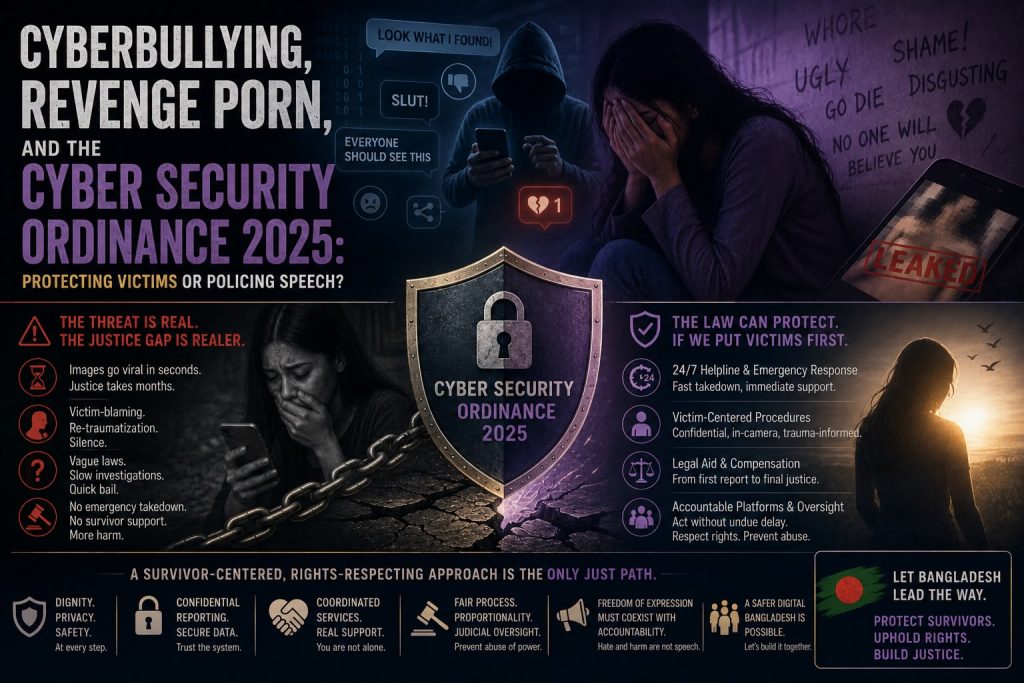
Introduction: For a young woman in Bangladesh, one notification sets off her life: An intimate photograph, now weaponized is shared without her consent, an age-old story of image-based sexual abuse that the survivors call “torture for the soul.”[1] But most never seek help and those who do are too often failed, not reporting enough is very common, police responses remain insufficient, and victim-blaming weakens trust even as a new law offers protection.[2] Mixed are the lessons from our history of law: systems are full of uncertainties; online abuse is reduced; survivors are already silenced by shame before justice can begin.[3] Step forward the Cyber Security Ordinance 2025: a bold[4] correction of course which criminalizes online violence and rights old wrongs[5] but whose quickly reactive shape and ongoing confusion, all among uneven capacity-building, could end up exchanging protection for thought policing unless the limits are concrete not surface-level.
Promise of Protection: It criminalizes the creation, storing, and sharing of these now-problematic crimes, including revenge porn, sextortion, blackmail, anonymous child-abuse chats, and AI-generated C-SAM, and the crimes that people were afraid to name will now be named under Section 25 as it is gazetted, making the law ready for stronger action.[6] It also focuses on the most vulnerable: as targeted by and for a female or child (where penalties increase strongly) these are adjacent to detailed definitions of digital child sexual abuse which now features data on national disproportionate harm online.[7] And it provides a pathway for recovery: Cyber Tribunals can award compensation under Section 30, augmented by pre-existing procedures in the Code of Criminal Procedure and specific victim-compensation provisions for women and children.[8] Procedurally the government brings an order to identify prevent and try cybercrimes under tougher categories and with judicial careful checking and provisions for crimes against women/children moving beyond wordy clauses to documented protection.[9] Importantly this promise builds on Bangladesh’s protective framework, from safe custody and anti-oppression laws to clear-cut definitions of image-based abuse and sextortion, as well as seeking to address the emerging AI-enabled harms.[10]
The Critical Gap: A Punitive Law Without a Protective Shield: Justice delayed is justice denied: a victim’s images go viral on the one hand while reactive pipeline, police first, investigation before any court action, vague AI provisions and thin capacity, makes the process take longer and does major harm.[11] The procedure is the punishment: report (in a public area and be re-traumatized) survivors are told “Nothing will happen to him”, private and sensitive to survivors’ emotions pathways and private consultations remain rare cases vs the norm.[12] Ambiguity increases the size of the wound: the meaning is not clear (hard to leave empty-handed), and neither is who are responsible (several cases in the era of deepfakes are similar) nor who can step in in a specialized way; more than that, it may also be quick bail when there is effort on trust at the front line.[13] What is lacking is an ’emergency room’, a plain and fast state-backed take down and survivor control akin to e-Safety’s direct platform engagement in addition to rapid health, legal and referral support as opposed to long court-centric relief.[14] Build shields, as well as swords: anonymous 3-digit and chatbot channels; youth- and women-responsive access; trained clinicians and working together agencies; questioning that prevents revictimization and restores control.[15]
Legal Analysis: Section 8’s blocking power is state-centric, compromises adjusted to “digital security/public order,” not a victim’s emergency right, and with investigations extended from 60 to 90 days under draft practice, vague thresholds and weak safeguards, it cannot stop viral spread fast enough and risks rights abuse.[16] In fact in practice the act is punishment: uncaring victims go to friends or family rather than police; we receive humiliation and disbelief upon arrival; unfair to women questioning and male-dominated not getting involved when settlements appear soon, help-seeking disappears before protection can even begin.[17] Training does not translate: capacity debates concentrate on investigation officers and forensics respondents weakly are still no better to achieve the safety-survival skills, as evidenced in open-court being harmed again; arguing in an adversarial court as a hostile witness versus accused often happens (long waiting time for treatment; loss of trust lost to legal agency).[18] Procedural protections for dignity and privacy are very little: very broad search/seizure powers; low thresholds; an appearance of limits leaves intimate personal details exposed; stigma and traumatic harm multiply at every step in the system.[19] A just remedy requires victim-driven quick takedown; made anonymous and in-camera pathways; legal aid from first report to judgment;[20] and high levels of proportionality and judicial supervision incorporated into enforcement.[21]
Reform Proposal: Fix it up a victim-first spine on the Ordinance: deliver us with a 24-hour emergency injunction to address Section 25 harms that requires quick platform take down, based on e-Safety’s removal notices, built around due-process “reasons,” proportionate geographic scope and trusted reporter priority, so takedown is fast, legal and rights-respecting. Stand up a National Cyber-Victim Support Cell under Section 5 to provide a 24/7 helpline for victims; rapid content quick review with platforms or real-time presence in chat rooms; and combined health-legal care, including first-line support and informed consent as well as privacy rules (by not asking survivors to delete the harmful material until law enforcement contacts their platform) for trauma-informed safety planning and multidisciplinary education of police officers/prosecutors/judges/clinicians. [20,22,] Front-end reporting tools warranted to ensure confidentiality (anonymity impossible), low re-telling of details that preserve dignity and encourage statements; secure routing of evidence with clear processes around disclosure rules/API-ready notices/user-friendly templates protected complainants while supporting prompt moderation and legal cooperation.[22] The obligations on the platform to act “without undue delay”, training of moderators and service-designers on such duties, the introduction of focused measures to protect minors, so long as they are effective, discouraging, proportionate and aligned to avoid breaking things apart, while at all time putting first victims’ rights.[23]
Conclusion: The Ordinance is a solid frame, but it needs a soul, one that focuses on survivors’ rights, consent, safety and confidentiality at every step, not just punishment. Justice that is real moves fast and listens: fast one-sided emergency orders of court; after-hours points of access to the courts; trained helplines staffed 24/7 by lawyers who do something now not next week.[24] Build caring infrastructure: end-to-end multi-sectoral support with specialized counsellors and linked hotlines; in combination with independent oversight to hold platforms accountable and ensure speedy redress.[25] Do no harm to dignity and expression: Ensure that (non-pecuniary) damages are removed after notification within human-rights-proper processes; build in strong AI/media verification capacities; provide clear reporting tools; enshrine these fast remover as a comparative benchmark for the finality of normal human rights removal?. Our last plea is clear and urgent, let Bangladesh set the example with a survivor-centered and rights-respecting law: confidential reporting; secure data; free legal aid; safety planning; coordinated services and protocols that prevent re-victimization while delivering real accountability.
Footnotes:
[1] Clare McGlynn and others, ‘It’s Torture for the Soul: The Harms of Image-Based Sexual Abuse’ (2021) 30(4) Social & Legal Studies 541, 543, 550, 552; Powell A, Scott AJ, Flynn A and Henry N, Image-Based Sexual Abuse: An International Study of Victims and Perpetrators. Summary Report (RMIT University 2020) 5; Marium Salwa and others, ‘Online child sexual abuse: a convergent parallel mixed-method exploration among Bangladeshi youth’ (2025) 15 BMJ Open e091042, 6.
[2] NORC at the University of Chicago and the International Center for Research on Women, Case Study: Technology-facilitated Gender Based Violence in Bangladesh (USAID 2022) 4; Rozina Akter Nishu, ‘Cybercrime and Teenage Psychology in Bangladesh: Is There a Silent Epidemic?’ The Asian Age (2 June 2025) https://dailyasianage.com/news/338060/cybercrime-and-teenage-psychology-in-bangladesh-is-there-a-silent-epidemic accessed 12 November 2025.
[3] NORC at the University of Chicago and ICRW (n 2) 4–5
[4] Faijul, ‘Cyber Security Ordinance 2025 — A Progressive Step or Another Digital Dilemma?’ BD Opinion JurIS (1 June 2025) https://bdopinionjuris.blogspot.com/2025/06/cyber-security-ordinance-2025.html? accessed 14 November 2025.
[5] Rozina Akter Nishu, ‘Cybercrime and Teenage Psychology in Bangladesh: Is There a Silent Epidemic?’ The Asian Age (2 June 2025) https://dailyasianage.com/news/338060/cybercrime-and-teenage-psychology-in-bangladesh-is-there-a-silent-epidemic accessed 12 November 2025.
[6] ‘New Cyber Ordinance: Stronger Shield for Women, Children’ The Daily Star (23 May 2025) https://www.thedailystar.net/bangladesh/news/new-cyber-ordinance-stronger-shield-women-children-3649696 accessed 14 November 2025; Cyber Security Ordinance 2025, s 2.
[7] Md Ariful Islam, ‘Not a Single AI-Related Case Has Yet Been Filed Under New Law’ The Business Standard (4 August 2025) https://www.tbsnews.net/bangladesh/crime/cyber-law-gaps-fail-shield-victims-ai-driven-abuses-1203876? accessed 14 November 2025;
[8] Safiqul Islam Chowdhury, ‘Legal Framework Regarding Victim Support and Compensation: Comparison between Bangladesh and US Laws’ (2022) 27(2) IOSR Journal of Humanities and Social Science 54, 57.
[9] BSS, ‘Govt Issues Gazette of Cyber Security Ordinance’ Prothom Alo (English) (22 May 2025) https://en.prothomalo.com/bangladesh/government/5gj5obvmuw? accessed 14 November 2025
[10] Toma DA, ‘Child abuse in Bangladesh: A socio-Legal analysis’ (2022) 5(3) International Journal of Law, Policy and Social Review 109, 113; NORC at the University of Chicago and International Center for Research on Women, Technology-Facilitated Gender-Based Violence in Asia: Bangladesh (USAID 2022) 1.
[11] Md Ariful Islam, ‘Not a single AI-related case has yet been filed under new law’ The Business Standard (4 August 2025) https://www.tbsnews.net/bangladesh/crime/cyber-law-gaps-fail-shield-victims-ai-driven-abuses-1203876
[12] United Nations Office on Drugs and Crime, Training curriculum on effective police responses to violence against women (United Nations 2010) 20; ActionAid Bangladesh, Research Findings: Online Violence Against Women in Bangladesh (2022) para 7.
[13] Md Ariful Islam, ‘Not a single AI-related case has yet been filed under new law’ The Business Standard (4 August 2025) https://www.tbsnews.net/bangladesh/crime/cyber-law-gaps-fail-shield-victims-ai-driven-abuses-1203876.
[14] Melanie Burton and others, ‘Regulating Image-Based Abuse: An Examination of Australia’s Reporting and Removal Scheme’ (2025) 2 Journal of Online Trust and Safety 1, 2, 7, 25.
[15] ActionAid Bangladesh, Research Findings (n 12) para 8;
[16] Transparency International Bangladesh, Digital Security Act 2018 and the Draft Cyber Security Act 2023: A Comparative Analysis (2023) 23.
[17] National Commission for Women, Gender Sensitization of Police Officers (2001) 2, 127; Mohaimenul Islam Arnab, ‘Cyber Violence Against Women in Bangladesh’ (2024) 6–7.
[18] Transparency International Bangladesh, Digital Security Act 2018 and the draft Cyber Security Act 2023 (n 16 ) 28.
[19] Mohaimenul Islam Arnab, ‘Cyber Violence Against Women in Bangladesh’ (2024) 7–8; Transparency International Bangladesh, Digital Security Act 2018 and the draft Cyber Security Act 2023 (n 16) 28–29.
[20] National Commission for Women, Gender Sensitization of Police Officers (n 17) 128, 200.
[21] Transparency International Bangladesh, Digital Security Act 2018 and the draft Cyber Security Act 2023 (n 16) 29–30.
[22] World Health Organization, Responding to intimate partner violence and sexual violence against women: clinical and policy recommendations (WHO/RHR/13.10, WHO 2013) 11.
[23] Ofcom, Illegal content Codes of Practice for user-to-user services (E03262389, 2024) 23-25.
[24] UN Women and others, Essential Services Package for Women and Girls Subject to Violence: Core Elements and Quality Guidelines (2015) 20, 35;
[25] WePROTECT Global Alliance, Preventing and Tackling Child Sexual Exploitation and Abuse (CSEA): A Model National Response (2016) 16-17; Report of the Secretary-General, Intensification of efforts to eliminate all forms of violence against women and girls: technology-facilitated violence against women and girls (GA, 79th Sess, 2024) UN Doc A/79/500 para 75.

Mahbubur Rahman