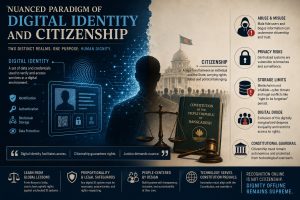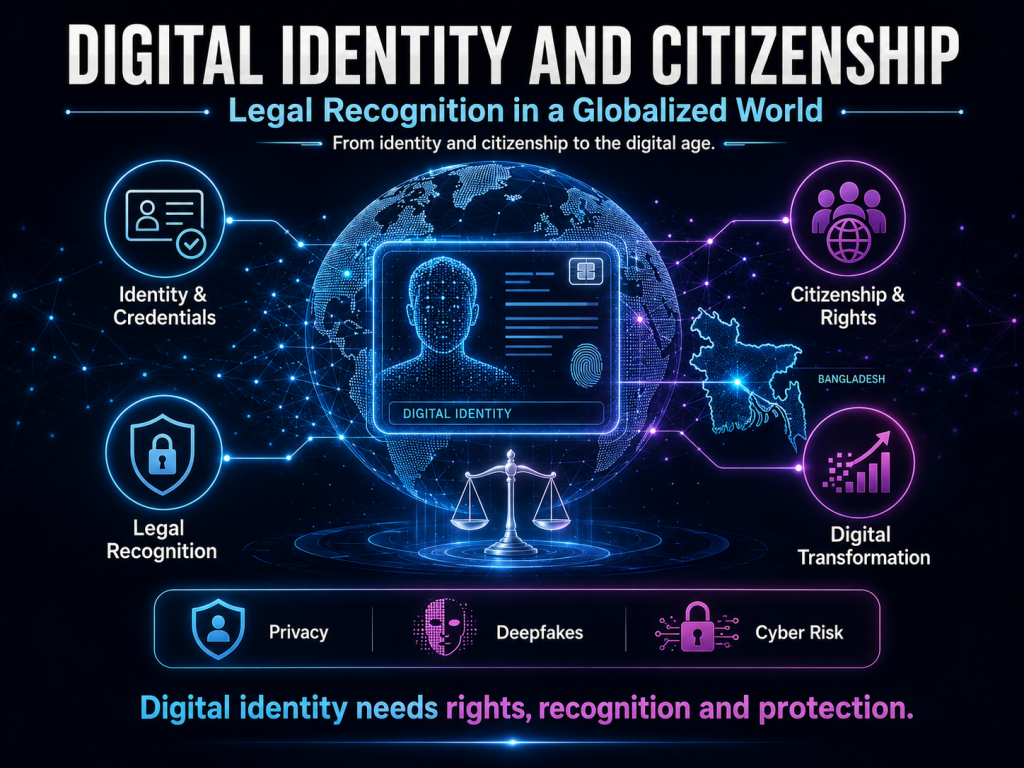
Introduction: The driving force of history is unique. The first driving force of history is the development of technique. In other words, it can be defined as the accumulation of knowledge that makes possible better control over nature, for the satisfaction of human need.1 The gradual improvement of digitalization is one of the greatest achievements of such human need that yielded to AI and continues to flourish the field with that intent. The progression made this world in a village by the boundaries of what we call the internet today. The world now runs by the data, of the data. Such information is now to be used for our digital identity and citizenship also. Digital identity means an identity composed of information and transmitted in the digital form.2 On the other hand, citizenship provides the validation of a person including certain rights and obligations within the territory of a nation. One has the representation of an entity and the other has the legal status of a natural person. Now digital citizenship is the method to harness citizenship in a digitalized way. They both work with a view to betterment of human needs. But, they are now at the corner of encroachment, the following course will elaborate the matter.
A comparative Study: The legal recognition of digital identity and citizenship, found to be in a very subtle yet sensitive matter. Now, almost everyone possesses and accesses a digital device and internet which is welcoming but a concerning issue as well. These digital creations have created a smaller space in order to connect us but also they carry the burden of uphold it. In a world of information, data is now the primary source and a weapon. Cyber crimes are increasing numerously and radically. Global cybercrime is expected to cost $10.5 trillion annually by 2025, up from $3 trillion in 2015.3 The numbers are numerous. We can not avoid the usage and risks as we live in the age of technology.
If we think comparatively, then in Norway 150,000 people have encountered identity theft online.4 The reason is mostly blamed upon the social media and other online portals.5 They possess the data and use it to sell it. In a report, it is found that, Three of those companies SerpApi; a Lithuanian start-up, Oxylabs; and a Russian company, AWMProxy — sold data to A.I. companies like OpenAI and Meta.6 These data are used and monitored by companies in order to avail themselves of profit and beyond. Another source claims that, “The companies have handed over data on 3.1 million accounts to the U.S. authorities over the last decade, providing data including emails, files, messages and other highly personal information.”7 The percentage of sharing those data is numerous. These are not suspicions, “ A jury finds Meta’s involvement of privacy law infringement.”8 Another lawsuit found to direct Google to pay a fine for encroaching privacy regulations, related with trafficking features.9 So, it is apt to state that your data are not safe at all despite not giving permission!
On the other hand, in Bangladesh, cyber crimes are very common in nature nowadays. But what is alarming is that our fellow countrymen are not aware of the procedure to remedy such crimes. In addition, the legal framework and other agencies are also very fragile in nature. A report by Daily Star “4,452 cases are still pending till June 30, 2025. The reasons include the prompt act of police agencies, missing witnesses and lack of sources”.10
Bangladesh Bank, itself could not save itself from the cyber attack let alone the public in general. “In 2016, a cyber robbery unleashed on Bangladesh Bank amounted to $1 billion dollars.”11 Though the country has enacted numerous laws for the protection of its interest, such laws used for political vendetta and beyond. A source claims that it is well established that the agencies spend Tk. 1,382 crore for purchasing surveillance.12 In addition, it suggests that police built a broader tactical surveillance capacity, and their purchases included high-end IMSI catchers, GPS trackers, satellite communication analysers, speaker recognition systems, and Man-in-the-Middle tools capable of intercepting encrypted communications and injecting spyware.13 So, the point is the protector of the system who is to implement and regulate such laws, are encroaching and abusing their powers. It is the ultimate breach of the social-contract theory that is the base of the modern world.
The Information and Communication Technology Act, 2006 (ICT, 2006) is the first and foremost law in Bangladesh for digital purposes. It provides legal recognition of digital records and signatures.14 In section 82, it provides and directs for the establishment of a cyber tribunal across the country.15 The law works along with the enacted law in 2025.16 The act gives unfettered right to the investigating officer to search and arrest.17 But it is an outdated law. It required some new backing in order to prevent the modern crime. It lacked the ability to introduce new and updated tools for society like AI, Social Media and others. Thus a new law came to force as the Digital Security Act, 2023.
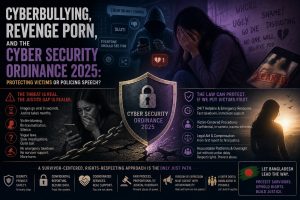
Information Communication and Technology Act (2006) to Cyber Act, 2023 were enacted for the purpose of protecting your data but in essence, these were done for a systematic, organized process to compel and use data arbitrarily for the political purposes only. The Cyber Act, 2023 sparked huge controversy. A report by Amnesty International vehemently says that, “The CSA uses almost all of the oppressive provisions of the repealed Digital Security Act (DSA) 2018 and Section 57 of the Information and Communications Technology (ICT) Act 2006 that preceded it, and has been used as weapon to target journalists, human rights defenders and dissidents despite the former government’s repeated assurances to the contrary.”18 The same law in the new name, indeed. Recently a new ordinance was introduced named, Cyber Security Ordinance 2025 surpassing and repealing the older Cyber Security Act. The new law repealed the nine controversial sections of the previous act. In addition, the act introduced the misuse of AI, online harassment, gambling provision and punishment.19 The amendments made are welcoming, such as, internet access is a civil right, use of AI for criminal activities legally recognised as a crime first in South Asia, the report claims.20
Digital Citizenship and Global World: Citizenship is a very important factor in the modern world. It plays the peripheral factor of every nation. It provides the citizens of the nation certain rights, duties and burdens also. It first emerged in the Greek city state of Athens. Throughout the course of time it was shaped and harnessed for the people of few. After the French Revolution, it took a new turn, where the concept of state emerged first. The objective of the citizenship is to organize the people, having recorded their number politically, socially and economically. It was done for collection of taxation, political participation, identity and beyond. The modern system of citizenship carries the rights, responsibilities, duties of every person socially and politically. In terms of dual citizenship, Bangladesh allows the citizens of Europe, North America or other countries provided by the permission of Govt.21 It enables the person to apply for Dual Nationality certificate before the Home Ministry, that may be accepted later by the Government. Now, it is high time for arranging the citizenship process in a more digitalized and in an organized way. Though countries are still in their inception to organize such programmes due to lack of integrity and online perplexities. Australia is the first country to recognize digital and citizenship that provided reciprocal rights to its citizens.22 But, in doing so in a strict legal framework would enable any person to become a digital citizen and world citizen. It requires political, social consensus that can be done through bilateral discussions and diplomatic ways. It needs to be done, for the greater good of every person in the world.
Conclusion: Till now, the right to privacy has been the main focus of legal scholarship and policy development.23Various reasons can be drawn for digital identity and citizenship in the globalized world. It is itself a human right. Digital identity is fundamentally changing the way the government provides essential services, and transacts with its citizens.24 It requires integrity and beyond for the agencies to be ratified. Thus, it is the responsibility of the government and the international community to come to a consensus and produce a connecting formula for their peoples respectively. Parliament must enact stronger laws so that organizations can be run independently without having a partisan attitude.. Also, an ombudsman needs to be exercised in order to check and balance the government agencies and others. Progress is the ultimate goal.
Footnotes:
- Neil Faulkner, A Radical History of the World, (first published 2013, Pluto Press 2018) 33 ↩︎
- Clare Linda Sullivan, ‘Digital Citizenship and the Right to Digital Identity Under International Law’, (2015), Information Ethics and Security, <https://papers.ssrn.com/sol3/papers.cfm?abstract_id=2519806#paper-citations-widget > accessed on 13 November, 2025 ↩︎
- Blake Hall, How AI-driven fraud challenges the global economy – and ways to combat it (World Economic Forum, 16 January 2025) <https://www.weforum.org/stories/2025/01/how-ai-driven-fraud-challenges-the-global-economy-and-ways-to-combat-it/ > accessed on 13 November, 2025 ↩︎
- David Nikel, Identity Theft in Norway, (Life In Norway, 1 July 2025) <https://www.lifeinnorway.net/identity-theft-in-norway/ > accessed on 13 November, 2025 ↩︎
- Ibid ↩︎
- Mike Issac, Reddit Accuses ‘Data Scraper’ Companies of Stealing Its Information, (The New York Times, 22 October 2025), <https://www.nytimes.com/2025/10/22/technology/reddit-data-scrapers-perplexity-theft.html > accessed on 13 November, 2025 ↩︎
- Emma Wollacott, US Government Demands Millions Of Google, Apple And Meta User Accounts, (Forbes, 27 February 2025 ) <https://www.forbes.com/sites/emmawoollacott/2025/02/27/us-govt-demands-millions-of-google-apple-and-meta-user-accounts/ > accessed on 13 November, 2025 ↩︎
- Jonathon Vanian, California jury rules Meta violated privacy law in case involving period-tracking app (CNBC, 7 August 2025) <https://www.cnbc.com/2025/08/07/jury-rules-meta-violated-law-in-period-tracking-app-data-case.html > accessed on 13 November, 2025 ↩︎
- Peter Hoskins and Lily Jamali, Google told to pay $425m in privacy lawsuit (BBC, 4 September 2025) <https://www.bbc.com/news/articles/c3dr91z0g4zo > accessed on 13 November, 2025 ↩︎
- Ashutosh Sarkar and Emrul Hasamn Bappi, Cybercrime cases pile up as trials stall for years (The Daily Star, 13 September 2025) <https://www.thedailystar.net/news/bangladesh/crime-justice/news/cybercrime-cases-pile-trials-stall-years-3984556 > accessed on 13 November, 2025 ↩︎
- Serajul I. Bhuiyan, Revisiting BB cyber heist: A call for enhanced cybersecurity measures (The Financial Times, 23 February 2025)<https://thefinancialexpress.com.bd/views/views/revisiting-bb-cyber-heist-a-call-for-enhanced-cybersecurity-measures > accessed on 13 November, 2025 ↩︎
- Zyma Islam, Mohammad Suman and Mahmudul Hasan, AL govt’s Secret Surveillance State (The Daily Star, 11 August 2025)<https://surveillancestate.thedailystar.net/ > accessed on 14 November, 2025 ↩︎
- Ibid ↩︎
- The Information and Communication Technology Act 2006, ss 6 & 7 ↩︎
- The Information and Communication Technology Act 2006, s 82 ↩︎
- The Cyber Security Ordinance 2025, s 42 (1) ↩︎
- The Information and Communication Technology Act 2006, s 80 ↩︎
- Bangladesh: Interim Government must restore freedom of expression in Bangladesh and repeal Cyber Security Act (Amnesty International, 8 August 2024)<https://www.amnesty.org/en/latest/news/2024/08/bangladesh-interim-government-must-restore-freedom-of-expression-in-bangladesh-and-repeal-cyber-security-act/ > accessed on 14 November, 2025 ↩︎
- The Cyber Security Ordinance 2025, Chapter VI ↩︎
- Cyber Security Ordinance approved with softer penalties, more bailable offences (The Business Standard, 6 May 2025)<https://www.tbsnews.net/bangladesh/govt-approves-cyber-security-ordinance-2025-repeals-9-sections-previous-law-1135181 > accessed on 14 November, 2025 ↩︎
- The Bangladesh Citizenship (Temporary Provisions) Order, 1972 (President’s Order), s (2B)(2) ↩︎
- Claire Sullivan,‘Digital citizenship and the right to digital identity under international law’ (2016) 32 (3) Computer Law and Security Review,<https://www.sciencedirect.com/science/article/abs/pii/S0267364916300292 > accessed on 15 November, 2025 [Hereinafter mentioned as, “Claire”] ↩︎
- Ibid ↩︎
- Ibid ↩︎

Korno Basak