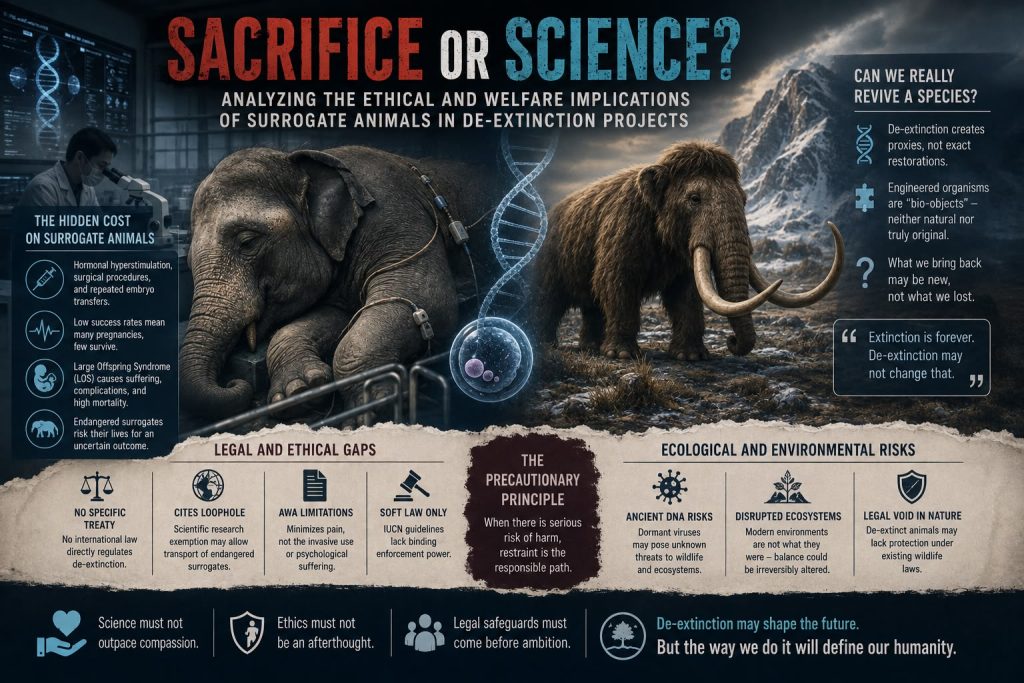
Introduction: De-extinction refers to the process of attempting to reintroduce extinct species using contemporary genomic methods. Such methods encompass selective breeding, Somatic Cell Nuclear Transfer (SCNT), genome editing, and artificial selection.1 Scholars such as Sherkow and Greely believe that de-extinction would overcome human-caused biodiversity loss and restore damaged ecosystems.2 However, Novak et al. emphasized that the science behind de-extinction has major shortcomings, as old DNA is often fragmentary and can potentially lead to harmful interactions.3 In this article, I intend to discuss whether de-extinction projects can be ethically justified given the physical and psychological pressures on surrogate animals, and whether they should be continued without sufficient legal protections in place.
Can We Actually Revive a Species?: Somatic Cell Nuclear Transfer (SCNT), a type of cloning in which the nucleus of a donor body cell is inserted into a hollowed egg to create an embryo, is the most notable approach to de-extinction.4 As a practical matter, the genetic material of an extinct species is initially examined using preserved specimens. The genomes of living relatives are sequenced, and cells are edited using CRISPR/Cas9 to substitute their DNA sequences with synthesized material from the extinct species. The edited nuclei are then inserted into an embryo-forming cell through SCNT, and the resultant embryo is implanted into a living surrogate to foster its growth and development.5 In an attempt to bring woolly mammoths back to life, researchers at Colossal Biosciences are modifying Asian elephant DNA to introduce mammoth characteristics, such as thick hair, antifreeze proteins, and cold tolerance.6 If achieved, the result would be a cross between an elephant and a mammoth, rather than a mammoth.
De-extinction as a whole should be interrogated before the ethical cost of surrogate animals. The term extinct itself may prove this impossibility. Alastair S. Gunn argues in ‘The Restoration of Species and Natural Environments’7 that any species that has evolved to a null class, a group of species of which there are no current instances, can never rationally be restored. He further argued that any organism produced by de-extinction processes could fall into a species that no longer exists. Instead, it would be something new. This conclusion is refined in the bio-objectification literature. Martinelli et al. argue that organisms engineered by biotechnology become bio-objects, entities that are neither natural nor artificial but rather in some intermediate state with no biological designation.8 The IUCN has quietly accepted this fact and indicated such animals as quiet proxy species, but not true restorations.9
The Biological Toll on Surrogate Animals: The scientific reality of de-extinction, particularly through SCNT, is inefficient and physically demanding for the surrogate animals. In the case of the Pyrenean ibex (bucardo), the only extinct animal to be briefly de-extinct in 2003, researchers transferred 439 cloned embryos into 57 surrogate goats. Only seven pregnancies were reported, and only one was carried to term. The resulting clone died minutes after birth due to physical defects, demonstrating the significant biological inefficiency involved.10 Scholars Pasqualino Loi and Grazyna Ptak argue that these low success rates necessitate the use of vast numbers of surrogates, subjecting them to hormonal hyperstimulation and repeated surgical embryo transfers.11
A major welfare risk documented in the cloning literature is Large Offspring Syndrome (LOS), a condition in which cloned fetuses grow disproportionately large.12 This causes hydrops, fluid accumulation in the fetus, and placental abnormalities, which in turn lead to dystocia or obstructed labor. Caesarean sections are frequently required and can be fatal without specialist veterinary care.13 Despite these risks, the surrogate body remains the primary biological limiting factor in the entire process.14 For instance, the Asian elephant is significantly smaller than the historical woolly mammoth, meaning that carrying a mammoth-hybrid fetus presents a distinct risk of uterine rupture.15 As noted by Bennett et al. in Nature Ecology and Evolution, Asian elephants are themselves endangered. Utilizing reproductive females for high-risk experimentation depletes the breeding population of an existing species to produce a hypothetical one.16
Legal and Bioethical Frameworks: There is no treaty of international law that specifically deals with de-extinction. Surrogate species are somewhat protected by the Convention on International Trade in Endangered Species (CITES), which limits cross-border animal movement among endangered species.17 However, Article III of CITES provides an exemption for scientific research, meaning that endangered surrogate animals, such as the Asian elephant, could potentially be transported across borders for de-extinction experiments under this provision without triggering the full weight of its protections. The United States has the Animal Welfare Act of 1966 (AWA), which establishes minimum animal standards for research.18 However, the AWA is concerned with the reduction of pain and not with the ban on invasive use. According to Legal scholar Norman W. Fenton, the law reaches general permissibility in the instrumentalization of the surrogate animal as long as surgery is carried out under anesthesia.19 The mental torture of imprisonment, especially on animals with a complex intellect, such as elephants and cetaceans (whales and dolphins), is largely unknown within the current laws.20
Soft Law Gaps and the Precautionary Principle: International guidance exists but lacks enforcement power. In 2016, the International Union on Conservation of Nature (IUCN) released Guiding Principles on the creation of proxies for extinct species, including a written requirement to observe animal welfare laws.21 However, the IUCN is not legally binding. At the treaty level, one could consider the Convention on Biological Diversity (CBD) and its Cartagena Protocol, under which the term genetically modified organism is mentioned; however, the current text was drafted to target plants and microorganisms rather than de-extinct animals.22 Legal experts Carlin, Wurman, and Zakim contend that a large number of de-extinct creatures might not be covered by statutory protection at all without recognition as an independent population of a listed species.23 The outcome is a grey area in the law. These animals may not be protected as wildlife or regulated as laboratory animals. Ethicists are broadly in agreement that the precautionary principle, which states that where there are serious possibilities of harm, restraint becomes the order of the day until the provision of sufficient protection prevails, should be the guiding principle that guides further development in this subject.24
Environmental and Ecological Risks: The risks of de-extinction extend beyond individual surrogate animals to broader ecological systems. Sherkow and Greely raised concerns that ancient DNA sequences may contain dormant endogenous retroviral remnants embedded in ancestral genomes over millions of years of evolution. Reactivating such sequences through genome engineering could introduce pathogenic materials into the host. If a surrogate animal carries and transmits such a pathogen to wild conspecifics, the consequences for wildlife populations could be significant, although this remains speculative rather than certain.25 A separate ecological concern involves the reintroduction of proxy species into modern environments. Ecosystems have substantially reorganized since the extinction of the original species. The ecological role once occupied by woolly mammoths no longer exists in its original form. Introducing a mammoth hybrid into the Arctic tundra could disrupt predator-prey relationships, vegetation patterns, and microbial soil communities in ways that are difficult to model in advance. Legal scholars Carlin, Wurman, and Zakim note that de-extinct animals released into nature may not qualify for protection under existing wildlife statutes, creating a regulatory gap at precisely the moment when oversight is most needed.26 These considerations do not render de-extinction impermissible in principle, but they reinforce the case for rigorous pre-release assessments before any project advances beyond the laboratory stage.27
Conclusion: De-extinction intersects with remarkable scientific ambition and ethical complexity. In this article, I have shown that current methods impose substantial physical burdens on surrogate animals, including hormonal hyperstimulation, surgical embryo transfer, and complications from Large Offspring Syndrome. These burdens are structural, not peripheral. Legally, frameworks like CITES, the AWA, and the CBD are not designed for de-extinction, and the IUCN Guiding Principles, while instructive, lack binding authority. De-extinct animals risk a regulatory vacuum, qualifying neither as protected wildlife nor as regulated laboratory animals. Together, welfare burdens, legal gaps, and ecological uncertainties make a compelling case for restraint. This is not an argument against de-extinction in principle; rather, it argues that the ethical and legal conditions necessary to justify de-extinction do not yet exist. Until those conditions are met, or technologies such as ectogenesis remove the reliance on living surrogates, the ethical case for proceeding remains unconvincing.
Footnotes:
- Stephen D Turner, Anna Keyte, Andrew Pask and Beth Shapiro, ‘De-Extinction Technology and its Application to Conservation’ (2025) Journal of Heredity 1; IUCN Species Survival Commission, IUCN SSC Guiding Principles on Creating Proxies of Extinct Species for Conservation Benefit (version 1.0, IUCN SSC 2016) ↩︎
- Jacob S Sherkow and Henry T Greely, ‘What If Extinction Is Not Forever?’ (2013) 340 Science 32 ↩︎
- BJ Novak and others, ‘De-Extinction: Science, Ethics and Politics of Resurrection Biology’ (2018) 9 Genes e548 ↩︎
- Akihiro Ogura, Satoshi Inoue and Teruhiko Wakayama, ‘Recent Advancements in Cloning by Somatic Cell Nuclear Transfer’ (2013) 368 Philosophical Transactions of the Royal Society B: Biological Sciences 20110329 ↩︎
- Turner and others (n 1); IUCN SSC (n 1) ↩︎
- Colossal Biosciences, ‘Woolly Mammoth De-Extinction’ (Colossal Biosciences) < https://colossal.com/mammoth/> accessed 4 April 2026 ↩︎
- Alastair S Gunn, ‘The Restoration of Species and Natural Environments’ (1991) 3 Environmental Ethics 291 ↩︎
- Lucia Martinelli, Markku Oksanen and Helena Siipi, ‘De-extinction: a novel and remarkable case of bio-objectification’ (2014) 55 Croatian Medical Journal 423
IUCN SSC (n 1) ↩︎ - IUCN SSC (n 1) ↩︎
- Josep Folch and others, ‘First Birth of an Animal from an Extinct Subspecies (Capra pyrenaica pyrenaica) by Cloning’ (2009) 71 Theriogenology 1026 ↩︎
- Paolo Loi and Grazyna Ptak, ‘Cloning Endangered Species: A Faint Hope’ (2013) 31 Trends in Biotechnology 443 ↩︎
- LE Young and others, ‘Large Offspring Syndrome in Cattle and Sheep’ (1998) 3 Reviews of Reproduction 155 ↩︎
- P Chavatte-Palmer and others, ‘Placental Perturbations Induce the Developmental Abnormalities Often Observed in Bovine Somatic Cell Nuclear Transfer’ (2012) 33 Placenta S99; JR Hill, ‘Incidence of Abnormal Offspring from Cloning’ (2014) 16 Cloning and Stem Cells 12 ↩︎
- Hannah Browning, ‘Won’t Somebody Think of the Mammoths? De-Extinction and Animal Welfare’ (2018) 31 Journal of Agricultural and Environmental Ethics 785 ↩︎
- Beth Shapiro, How to Clone a Mammoth: The Science of De-Extinction (Princeton University Press 2015) 45 ↩︎
- JR Bennett and others, ‘Spending Limited Resources on De-Extinction Could Lead to Net Biodiversity Loss’ (2017) 1 Nature Ecology and Evolution 0053 ↩︎
- Convention on International Trade in Endangered Species of Wild Fauna and Flora (adopted 3 March 1973, entered into force 1 July 1975) 993 UNTS 243 (CITES), art III ↩︎
- Animal Welfare Act 1966 (US) 7 USC §§ 2131-2159 ↩︎
- NW Fenton, ‘Legal Rights for De-Extinct Species’ (2018) 24 Animal Law Review 1 ↩︎
- Steven M Wise, Rattling the Cage: Toward Legal Rights for Animals (Da Capo Press 2000); Gay A Bradshaw, Elephants on the Edge: What Animals Teach Us about Humanity (Yale University Press 2009) ↩︎
- IUCN SSC (n 1) ↩︎
- Convention on Biological Diversity (adopted 5 June 1992, entered into force 29 December 1993) 1760 UNTS 79, art 2; Cartagena Protocol on Biosafety to the Convention on Biological Diversity (adopted 29 January 2000, entered into force 11 September 2003) 2226 UNTS 208 ↩︎
- Norman F Carlin, Ilan Wurman and Tamara Zakim, ‘How to Permit Your Mammoth: Some Legal Implications of “De-Extinction”‘ (2014) 33 Stanford Environmental Law Journal 3 ↩︎
- Shlomo Cohen, ‘The Ethics of De-Extinction’ (2014) 8 NanoEthics 165 ↩︎
- Sherkow and Greely (n 2) 32-33 ↩︎
- Carlin, Wurman and Zakim (n 22) 3 ↩︎
- IUCN SSC (n 1); Cohen (n 23) 165 ↩︎

Mir Fahmida Sultana