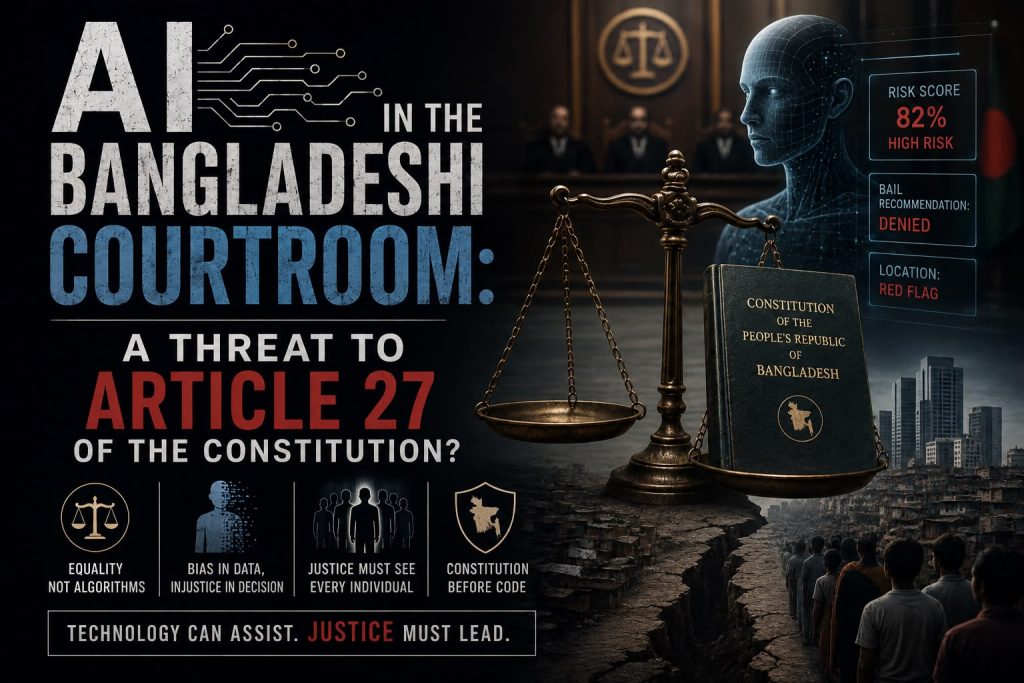
AI in the Bangladeshi Courtroom: A Threat to Article 27 of the Constitution?: Imagine a judge that never sleeps. A judge that can process a thousand cases before breakfast. We are talking about using Artificial intelligence in the court, what seemed like science fiction is now a reality. The technology can now perform the tasks of lawyers and judges,[1] specially by making predictions, identifying relevant documents, answering questions and evaluating emotions at a higher standard than a human.[2] This makes it a powerful tool for providing access to justice for those who could not otherwise afford it.[3]
For Bangladesh, where the judicial system is burdened with the backlog of 4.5 million cases across all courts[4] as of December 31, 2024, such technology sounds compelling.The backlog isbreaching public trust[5] and has created a situation so dire that it threatens the very ideal of justice. Therefore, why not use such technology? Afterall, China’s ‘Smart Court’ in Hangzhou[6] can now generate a complete judgment after applying the law to the facts of a case.[7] Estonia is developing a RoboJudge for handling small claims.[8] Even England, which we know for its renowned legal system, has now issued guidance, permitting judges to use AI to assist with drafting.[9] Such allure is powerful. However, this blog contends that integrating such technology blindly in our legal system would violate the principle of ‘substantive equality’ in Article 27 of our Constitution.
The Constitutional Standard of Equality: Any test of AI’s constitutionality must begin with the Constitution itself. A plain reading of the preamble reveals a pledge to secure fundamental rights and freedoms for every citizen.[10] The legal standard for this test is found in Article 27, “All citizens are equal before law and are entitled to equal protection of law.” Through its numerous jurisprudences, Supreme Court has moved beyond ‘formal equality’, that everyone is judged by the same standard.[11] Instead it has embraced the principle of ‘substantive equality’. As Chief Justice S. Ahmed held in Bangladesh v. Md. Azizur Rahman,[12] equality does not dictate identical treatment, rather it requires that persons in different circumstances be treated differently accounting for real-world disadvantages and exclusion. This has led to the doctrine of ‘reasonable classification.’ Any distinction made by law must be based on a two-prong test, it must be founded upon an intelligible differentia i.e. a real understandable difference and that differentia must have a rational nexus to the law’s goal to achieve justice.[13] This theory is the living principle of our law. For example, in the Parental Identity Case[14], High Court saw the devastating impact of requiring a father’s name on school forms for the children of single mothers. It looked beyond the neutral rule and struck it down. The same principle was at work in Farida Akhter v. Bangladesh.[15] Instead of relying on a formal definition of equality, the Appellate Division upheld reserved parliamentary seats for women. It recognized the inequality that the women face, lagging behind in all spheres of national life. This is the constitutional standard that any judicial algorithm must pass.
How Algorithms Learn to Discriminate: An AI machine learning algorithm learns from the data it is trained on.[16] It finds patterns in that data and once it is trained, it applies those patterns to new situations.[17] The problem is that human data is often filled with hidden biases[18] so if an algorithm is trained on those biased data, it will reproduce them.[19] This is known as algorithmic bias.[20] Even when a developer forbid a model to use sensitive attributes like religion or ethnicity, the algorithm can still learn to discriminate by using neutral data that are closely associated with those attributes.[21] For instance, a person’s postal code, income level or even their name can reveal their race or socio-economic status.[22] The global experience AI in criminal justice shows how easily these systems can encode and discriminate.
In American courtrooms, an algorithm named COMPAS was used to predict which defendants were likely to reoffend. When the investigative journalists at ProPublica analyzed 7,000 of its decisions, they found that the machine was biased against Black defendants.[23] It wrongly flagged them as high risk nearly twice the rate it did white defendant and wrongly labeled the White defendants a low risk far more often than Black defendants.[24] Beyond this, algorithmic bias has been documented across multiple sectors. In South Africa, predictive policing algorithms have been found to increase surveillance in low-income communities and harassment of innocent individuals.[25] In banking, loan algorithms have evaluated minority groups as higher risk which significantly lessen the likelihood that bank will approve them.[26] In healthcare, one study found that a healthcare algorithm was biased against Black patients which lead to poorer health outcomes.[27] Even in hiring, algorithms in India have been found to discriminate against candidates from marginalized communities.[28] These examples show how algorithmic bias is not just confined to criminal justice system but across multiple sectors.
Such danger becomes deeply personal when applied in the courtroom in Bangladesh. Our country has long struggled with deep inequalities in several sectors. The wealthiest 10 percent of the population holds 41 percent of the nation’s income, while the bottom 10 percent holds just over one percent.[29] Education[30] and health[31] inequalities has also been found especially those between rural and urban areas. According to the World Bank, more than half of Bangladesh’s population lives in rural areas that lag behind urban centers in nearly every development measure.[32]
For example, Mymensingh division has the highest dependency ratio and lowest literacy rate, on the other hand, Dhaka division has the reverse.[33] Hypothetically, an algorithm trained on this data might not see ‘people’, it would merely recognize socioeconomic patterns. It could learn from the statistics that a person from Mymensingh or Rangpur might be more likely to be poor and less educated and has poorer transport system. Illustratively, if applied to a bail decision, the algorithm would predict whether the defendant will appear in the next court date if released.[34] It could disproportionately recommend denying bail because it’s training data might show that defendants from those regions are less likely to appear for court dates. Similarly, crime distribution across Dhaka reveals sharp geographic difference. Mohammadpur, Jatrabari, Tongi and Old Dhaka remain as the highest-crime area in Dhaka[35] where Mohammadpur alone accounts for a quarter of all high-risk mugging spots.[36] In such a theoretical deployment, an algorithmic model could learn that certain geographic areas are strongly associate with criminal activity, what known as ‘algorithm redlining’.[37] Therefore, a defendant from such area could theoretically receive a higher risk score than an identical defendant from Bashundhara simply because the algorithm has learned to associate his postal code with criminality.[38] This is where the algorithm fails the constitutional test. It takes what appears to be objective data through its training which are actually our society’s deepest biases.
Governing Judicial AI: Identifying the threat is the first step; the second is to prescribe a solution. Rather than rejecting such technology altogether, it should be deployed in a way that aligns with our constitutional values. To do this, we must learn from the global best practices.
The European Union has already pioneered a path. Instead of banning, the EU AI Act uses a risk-based approach, where it explicitly categorized any AI system as ‘high risk’ if it is intended for use in the administration of justice.[39] The developers must use high-quality and representative training data to prevent discrimination.[40] It should be oversighted by human[41] and must maintain a detailed technical documentation for transparency.[42] Guided by this international precedent and our Constitution, we must establish two foundational prerequisites for any judicial AI in Bangladesh.
First, we must introduce Algorithmic Impact Assessments (AIAs)[43] to be conducted for any use of AI in our court. This is the practical application of the EU’s high-risk framework and our own ‘reasonable classification’ test for the digital age. The burden of proof is on developers to show that the system is free from discriminatory proxies. We need a compliance protocol where independent auditors verify these before the government obtains the software.
Second, effective AI governance requires collaboration among key stakeholders. We must convene the Supreme Court, the Ministry of Law, Justice and Parliamentary Affairs and the Bangladesh Bar Council to establish strict rules about data ownership and liability. If an AI wrongly deny bail, who will be responsible? Furthermore, we must equip our judges with the technical understanding through Judicial Administration Training Institute (JATI). They must learn about the capabilities and limitations of AI.[44] A judiciary that does not understand AI cannot be expected to protect citizens’ rights from it.
The promise of AI in judiciary indeed sounds compelling yet we came to a conclusion how it could violate the doctrine of substantive equality that our judiciary has built over long jurisprudence. AI never truly operates through a neutral lens. It recognizes patterns in data rather than the human beings behind them. Therefore, our responsibility is to take a vigilant approach to its governance to protect our constitutional values. For the greatest danger is not a biased algorithm, but one that perfectly reflects the biases we have yet to overcome.
Footnotes:
[1] Richard Susskind, Tomorrow’s Lawyers: An Introduction to Your Future (3rd edn, OUP 2023) 256
[2] ibid 164.
[3] Maura R Grossman and others, ‘The GPTJudge: Justice in a Generative AI World’ (2023) 23(1) Duke Law & Technology Review, 27 https://scholarship.law.duke.edu/dltr/vol23/iss1/1/ accessed 11 November 2025.
[4] ‘Over 45 lakh cases pending in courts’ The Daily Star (Dhaka, 3 January 2025) https://www.thedailystar.net/news/bangladesh/news/over-45-lakh-cases-pending-courts-3933306 accessed 28 March 2026.
[5] Md Rezaull Karim, ‘Civil Judicial System of Bangladesh: Trial Level and Jurisdiction’ (2023) 6(3) Al-Qamar https://ssrn.com/abstract=4675826 accessed 12 November 2025.
[6] Jingjing Hao and Meng Chen, ‘Smart Courts: The Expansion of Technology in the Chinese Judicial System’ (2020) Advance 1 https://advance.sagepub.com/users/718270/articles/703525-smart-courts-theexpansion-of-technology-in-the-chinese-judicial-system accessed 11 November 2025.
[7] B Wei and others, ‘A full-process intelligent trial system for smart court’ (2022) 23 Frontiers of Information Technology & Electronic Engineering 186 https://link.springer.com/article/10.1631/FITEE.2100041 accessed 14 November 2025.
[8] Eric Niiler, ‘Can AI Be a Fair Judge in Court? Estonia Thinks So’ Wired (25 March 2019) https://www.wired.com/story/can-ai-be-fair-judge-court-estonia-thinks-so/ accessed 13 October 2025.
[9] Brian Malley, ‘Judges in England and Wales are Given Cautious Approval to Use AI in Writing Legal Opinions’ AP News (8 January 2024) https://apnews.com/article/artificial-intelligence-ai-guidance-england-wales-judges-c2ab374237a563d3e4bbbb56876955f7 14 October 2025.
[10] Jobair Alam and Ali Mashraf, ‘Fifty Years of Human Rights Enforcement in Legal and Political Systems in Bangladesh: Past Controversies and Future Challenges’(2023) 24 Human Rights Review. Pg. 121, 125
[11] Joseph Fishkin, Bottlenecks: A New Theory of Equal Opportunity (OUP 2014). Pg. 45
[12] Bangladesh v Md. Azizur Rahman and Others (1994) 23 CLC (AD)
[13] Sheikh Abdus Sabur v Returning Officer and Other (1989) 41 DLR (AD) 30.
[14] BLAST and others v. Bangladesh and others (HCD, Writ Petition No. 5343 0f 2009)
[15] Farida Akhter and Others v Bangladesh (2005) LEX/BDAD/0278/2005.
[16] Shai Shalev-Shwartz and Shai Ben-David, Understanding Machine Learning: From Theory to Algorithms (Cambridge University Press 2014) 19
[17] Christopher M Bishop, ‘Model-Based Machine Learning’ (2013) 371 Philosophical Transactions of the Royal Society A 20120002
[18] Gretel Tan, ‘(Un)Objective Machines: A Look at Historical Bias in Machine Learning’ (Towards Data Science, 17 April 2024) https://towardsdatascience.com/un-objective-machines-a-look-at-historical-bias-in-machine-learning-da5101d46169 accessed 14 November 2025.
[19] Zhisheng Chen, ‘Ethics and discrimination in artificial intelligence-enabled recruitment practices’ (2023) 10 Humanities and Social Sciences Communications 567 https://doi.org/10.1057/s41599-023-02079-x
[20] Maya C. Jackson, ‘Artificial Intelligence & Algorithmic Bias: The Issues with Technology Reflecting History & Humans’ (2021) 16 Journal of Business & Technology Law pg. 299.
[21] Gabbrielle M. Johnson, ‘Algorithmic bias: on the implicit biases of social technology’ (PhilSci-Archive, 2020) https://philsci-archive.pitt.edu/17169/1/Algorithmic%20Bias.pdf accessed 13 November 2025.
[22] Nithya Sambasivan and others, ‘Re-imagining Algorithmic Fairness in India and Beyond’ in Proceedings of the 2021 ACM Conference on Fairness, Accountability, and Transparency (FAccT ’21) (ACM 2021) https://doi.org/10.1145/3442188.3445896
[23] Julia Angwin and others, ‘Machine Bias’ (ProPublica, 23 May 2016) https://www.propublica.org/article/machine-bias-risk-assessments-in-criminal-sentencing accessed 14 November 2025.
[24] ibid
[25] Divya Singh, ‘Policing by Design: Artificial Intelligence, Predictive Policing and Human Rights in South Africa’ (2022) Just Africa 41.
[26] Laura Blattner and Scott Nelson, ‘How Costly is Noise? Data and Disparities in Consumer Credit’ (arXiv preprint arXiv:2105.07554, 2021) https://arxiv.org/abs/2105.07554 accessed 14 November 2025.
[27] Ziad Obermeyer and others, ‘Dissecting racial bias in an algorithm used to manage the health of populations’ (FTC PrivacyCon, 2020) https://www.ftc.gov/system/files/documents/public_events/1548288/privacycon-2020-ziad_obermeyer.pdf accessed 14 November 2025.
[28] Nilesh Christopher, ‘OpenAI is huge in India. Its models are steeped in caste bias’. (MIT Technology Review, 1 October 2025) https://www.technologyreview.com/2025/10/01/1124621/openai-india-caste-bias/ accessed 15 November 2025.
[29] Faisal Mahmud, ‘Bangladesh’s ‘missing billionaires’: A wealth boom and stark inequality’ (Al Jazeera, 11 June 2024) https://www.aljazeera.com/economy/2024/6/11/bangladeshs-missing-billionaires-a-wealth-boom-and-stark-inequality accessed 15 November 2025.
[30] Sakil Ahmmed and Md. Nadim Uddin, ‘Investigating educational inequality in Bangladesh: A decomposition analysis’ (Bureau of Economic Research Working Paper, 2024) https://ber.du.ac.bd/wp-content/uploads/2024/11/157-2023-WP-5-Investigating-Edcuational-Inequality-in-Bangladesh-A-Decomposition-Analysis-1.pdf accessed 15 November 2025.
[31] Masuda Akter and Humayun Kabir, ‘Health Inequalities in Rural and Urban Bangladesh: The Implications of Digital Health’ (2023) 1(2) Mayo Clinic Proceedings: Digital Health 201 https://doi.org/10.1016/j.mcpdig.2023.04.003
[32] Trading Economics, ‘Rural population (% of total population) in Bangladesh’ (Trading Economics, 2025) https://tradingeconomics.com/bangladesh/rural-population-percent-of-total-population-wb-data.html accessed 15 November 2025.
[33] Mehedi Hasan Manik, ‘Demographic and Socio-economic Changes in Bangladesh: Evidence from the Population Census in 2022’ (2024) 3(1) Formosa Journal of Sustainable Research 29 https://doi.org/10.55927/fjsr.v3i1.5762
[34] Jon Kleinberg and others, ‘Human Decisions and Machine Predictions’ (2018) 133(1) The Quarterly Journal of Economics 237.
[35] TBS Report, ‘Watch out for muggers: Home ministry publishes revised list of most dangerous areas across Dhaka, adjacent districts’ (The Business Standard, 24 February 2025) https://www.tbsnews.net/bangladesh/crime/watch-out-muggers-home-ministry-publishes-revised-list-most-dangerous-areas-across accessed 15 November 2025.
[36] ‘Mohammadpur’s mugging menace: How crime red zones shaking Dhaka’ (The Financial Express, 6 March 2025) https://thefinancialexpress.com.bd/national/crime/mohammadpurs-mugging-menace-how-crime-red-zones-shaking-dhaka accessed 15 November 2025.
[37] Anya E.R. Prince and Daniel Schwarcz, ‘Proxy Discrimination in the Age of Artificial Intelligence and Big Data’ (2020) 105 Iowa Law Review 1257.
[38] Lyria Bennett Moses and others, ‘Criminal Sentencing and Risk Assessment Tools’, in AI Decision-Making and the Courts: A Guide for Judges, Tribunal Members, and Court Administrators (Australasian Institute of Judicial Administration 2024) https://www.dfvbenchbook.aija.org.au/article/103158/3+Areas+of+AI+Use+in+Courts/3.4+Criminal+Sentencing+and+Risk+Assessment+Tools accessed 15 November 2025.
[39] Regulation (EU) 2024/1689 (Artificial Intelligence Act) OJ L 2024/1689, Annex III.
[40] AI Act, art 10.
[41] AI Act, art 14
[42] AI Act, art 11
[43] Dillon Reisman and others, ‘Algorithmic Impact Assessments: A Practical Framework for Public Agency Accountability’ (AI Now Institute, 9 April 2018) https://ainowinstitute.org/publications/algorithmic-impact-assessments-report-2 accessed 16 November 2025.
[44] Agnieszka McPeak, ‘Disruptive Technology and the Ethical Lawyer’ (2019) 50 University of Toledo Law Review pg. 457

M. Jonayed Al Ratul Rasel